The hospital room was finally quiet enough for me to hear my daughter breathe.
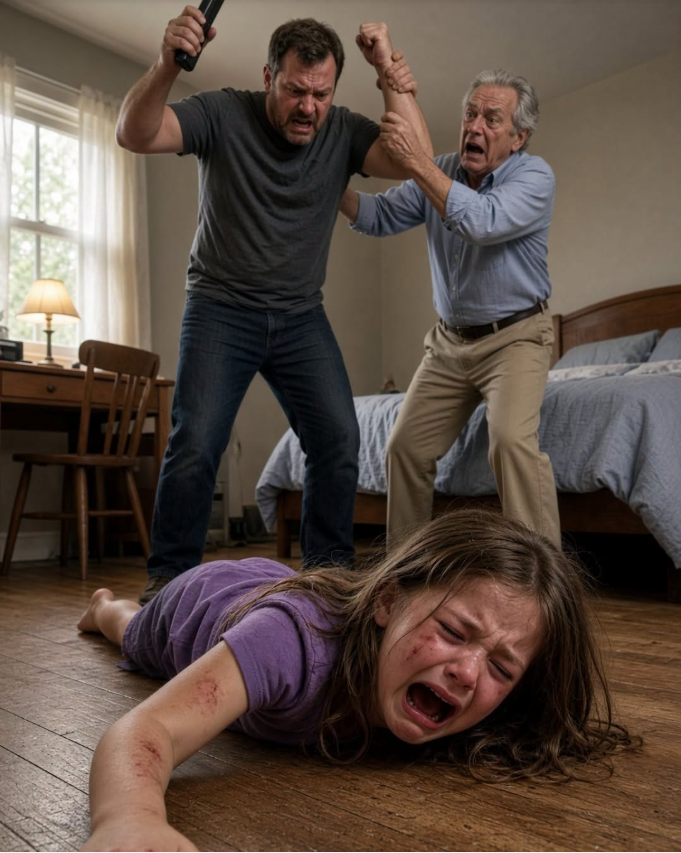
She lay beneath a white blanket, pale and exhausted, her small hand wrapped around mine. Doctors had treated the injury to her foot and explained that recovery would take time. Across the hall, my father was still being examined after the hammer blow to his head.
For the first time since police entered our house, nobody was shouting.
I thought the worst revelation was behind us.
Then my seven-year-old daughter squeezed my fingers.
Her eyes shifted toward the door.
Something in her expression frightened me.
“Yesterday he told me next time he’d use the hammer.”
My husband had ordered her to finish reading before she could play outside. She kept leaving her desk because she wanted to run in the yard. He became angry.
“He said if I got up again, he wouldn’t let me run anymore.”
Until that moment, part of me had been trying to understand what happened as an explosion of rage—a monstrous act committed in one uncontrollable moment.
Now that explanation disappeared.
And my daughter had been frightened enough to tell Grandpa.
“Because Dad said you’d be mad at me because I wasn’t studying.”
I pulled her against me as carefully as I could.
“I thought if I told you, he’d know.”
That sentence broke something inside me.
My seven-year-old had learned to calculate the consequences of telling me the truth.
A nurse entered to check her bandages. I stepped into the hallway because suddenly I couldn’t breathe.
An officer stood outside Dad’s room.
“She told you about yesterday?”
“She described an earlier threat involving the hammer.”
I folded my arms across myself.
“We preserved the emergency call.”
He explained that my father’s phone had remained connected to dispatch after he entered our house.
The call had captured more than I realized.
My husband ordering Dad to stay out of his family.
Dad saying he was taking his granddaughter away.
And afterward, my husband’s voice telling me to claim that my father had attacked him.
Whatever portions proved relevant would be preserved and reviewed as evidence.
There was no longer any way for me to pretend this had been one terrible misunderstanding.
My daughter suddenly becoming quiet when her father entered a room.
The way she studied his face before asking permission to play.
How quickly she apologized when she spilled something.
How often she asked, “Is Dad mad?”
I simply hadn’t understood what they meant.
My father had understood enough to worry.
That evening, he’d only come to return spare house keys.
Then he heard his granddaughter screaming.
He called for help before entering the room because he didn’t know what he was walking into.
And then he went toward her anyway.
Now he was lying in a hospital bed because he had refused to stand in the hallway and hope the screaming stopped.
When I returned to my daughter’s room, she was awake.
“The doctors are taking care of him.”
“But he came because I screamed.”
“You listen carefully. You didn’t make Dad hurt you. You didn’t make him hurt Grandpa. You didn’t cause any of this.”
“You are allowed to leave a desk.”
Several hours later, Dad regained consciousness.
The first thing he asked wasn’t where he was.
“She told me about yesterday,” I said.
“Earlier. She wouldn’t explain much. Just asked if I could come over.”
“Then when I got there and heard her screaming, I called emergency services before going upstairs.”
“You knew something was wrong.”
“I knew enough not to ignore it.”
After a moment, he asked quietly, “You believe her, don’t you?”
Because I understood what he was really asking.
Would I allow my husband to talk me back into doubt?
My husband was taken away that night.
Before he left, he tried once more to speak to me.
Said he’d been trying to discipline her.
Then he returned to the argument he apparently thought would save him.
“If you tell them everything, you’re going to destroy this family.”
“Our family was already inside that bedroom.”
“Our daughter was there. Dad was there. I was there.”
“You destroyed what we had before anyone called the police.”
The next morning, investigators interviewed me again.
This time I stopped protecting the image of my marriage.
I told them about my husband’s obsession with schoolwork.
His anger when our daughter couldn’t sit still.
The way she’d become increasingly cautious around him.
And when I didn’t know, I said so.
There was my daughter’s account.
Most importantly, there was an earlier threat that changed how I understood what happened.
My husband had assumed silence would protect him.
The following days were difficult.
My daughter repeatedly asked when we were going home.
Then one afternoon she asked the question beneath all the others.
Her entire body seemed to relax.
That reaction told me more than any explanation could have.
Then she looked at her injured foot.
“When this gets better, can I play outside?”
“As soon as your doctor says it’s safe.”
“As far as those legs want to take you.”
It was the first one I’d seen since that night.
When my daughter was finally able to visit him, she carefully approached his hospital bed.
“Because I didn’t tell sooner.”
“I’m proud of you for telling when you could.”
She slipped her fingers into his.
“Dad said I was bad because I wanted to run.”
My father looked directly at her.
“You listen to me. There is nothing bad about a seven-year-old wanting to run.”
I turned away because I couldn’t stop the tears.
She should never have needed to learn that lesson.
She should have been worried about cartoons and spelling tests and which shoes made her fastest.
Instead, she’d learned how to recognize danger in her own home.
I couldn’t promise she would forget.
And I couldn’t predict exactly what would happen through the legal process.
But there were promises I could make.
I could make sure she understood that telling the truth wasn’t betrayal.
I could teach her that discipline should never make a child afraid for her safety.
And I could stop confusing silence with keeping a family together.
Months later, when her foot had healed enough, I took her outside.
Dad came too, still moving more slowly than before.
My daughter stood at the edge of the yard.
That night had begun with a man trying to use fear to keep a seven-year-old in a chair.
But fear didn’t get the final word.
My husband had tried to control the story too.
He called the injury an accident.
But one emergency call had captured words he couldn’t take back, and one frightened little girl found the courage to say what had happened before anyone could rewrite it for her.
I still didn’t know what every court hearing would bring.
I didn’t know how long Dad’s recovery would take or which memories my daughter would carry into adulthood.
But I knew what would happen in our home.
And whenever she was ready, she would always be allowed to run.


0 commentaires:
Enregistrer un commentaire