“I made the list,” my sister admitted. “But I never told Mom to lock her outside.”
That sentence didn’t clear her.
It made me realize the chore list had existed before my daughter ever arrived.
I was still kneeling beside Emma in the gas station employee area. One of her hands was twisted into my shirt, as though she was afraid that if she let go, somebody might decide she no longer belonged with me.
“The chore list. Show it to me.”
He immediately lowered his eyes.
She reluctantly unlocked her phone.
What she showed me made my stomach turn.
There were ordinary chores listed beside her children’s names.
Beside Emma’s name were six jobs.
“I did the bathroom,” she whispered.
“You didn’t have to do any of it.”
“But Aunt Rachel said Grandma would be happy if I showed I could be useful.”
Words no eight-year-old should have been taught to connect.
Rachel was tired of fighting with her children about chores.
Then she finally reached the truth.
Even he seemed shocked hearing it spoken aloud.
“You saw my daughter as the child least likely to fight back.”
I immediately turned away from Rachel.
I thanked the gas station employees and gave my information to the responding officer who had arrived after the missing-child call. I explained what I knew and made sure Emma could speak without being surrounded by the relatives involved.
She followed me from room to room.
When I went downstairs to switch the laundry, she came with me.
When I took the trash outside, she stood at the door watching.
At bedtime, she appeared in the hallway wearing dinosaur pajamas.
“If I don’t do my chores tomorrow, can I still stay here?”
I sat on the edge of the bed and pulled her beside me.
“Emma, chores are things we do because we live together. They are not rent.”
“Money grown-ups pay to live somewhere.”
“Absolutely not. You’re eight. Your financial contribution to this household is terrible.”
“You can lose screen time. You can get consequences. You can be sent to your room. You can make me so frustrated I need ten minutes before I answer you.”
“But you cannot lose your home.”
“What if I say something mean?”
Only then did I understand how deeply one afternoon had frightened her.
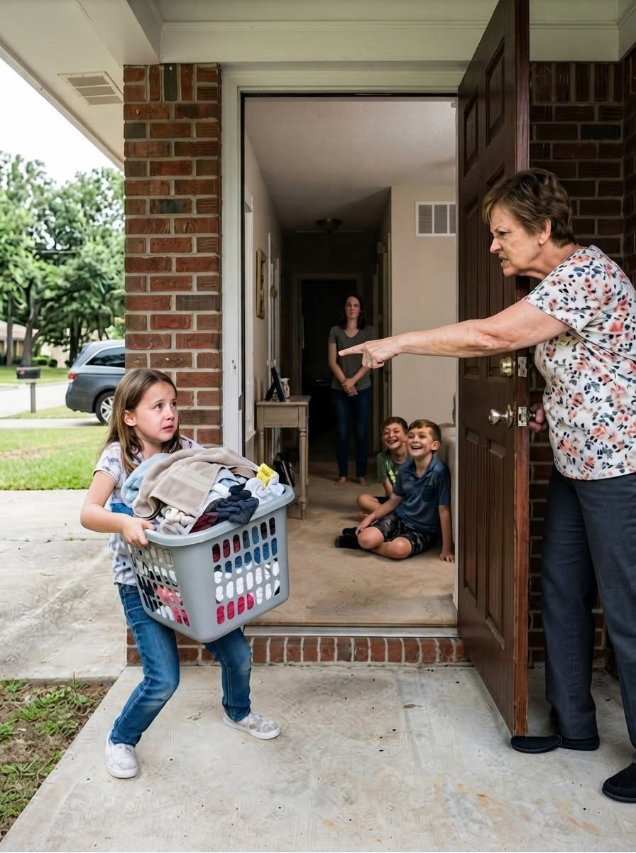
My mother hadn’t simply put Emma outside.
She had made safety conditional.
And children remember conditions.
Over the next several days, more details came out.
I let her talk when she wanted.
Sometimes information surfaced while we were driving.
Sometimes while brushing her hair.
Sometimes three minutes after bedtime, when children mysteriously remember everything important.
Mom had apparently been criticizing my parenting for months.
According to Emma, Grandma sometimes said I “babied” her.
Rachel had complained that her boys noticed Emma wasn’t expected to do the same chores at Grandma’s house.
Instead of recognizing the obvious—that Emma didn’t live there—Mom decided fairness meant giving her more work.
And when Emma finally said no, the adults treated her refusal as a character defect rather than asking whether an overloaded basket might actually be too heavy for an eight-year-old.
Rachel came to my house four days later.
She stood on the porch holding a folded piece of paper.
“Then that’s the first thing you should’ve asked.”
Because she still hadn’t understood that Emma’s feelings were no longer something adults got to manage for convenience.
“I should’ve called you immediately.”
“I shouldn’t have made that list.”
“I kept telling myself Mom was the one who put her outside.”
“You were trying to find the exact point where responsibility stopped belonging to you.”
That was the first useful thing she had said.
I asked Emma later whether she wanted the letter.
Her messages moved through predictable stages.
Then accusations that I was keeping her granddaughter away over “one mistake.”
“You’re right about one thing. It was one decision.”
“One decision to put a child outside. Then another decision not to bring her back. Another not to watch her. Another to let her disappear. Another not to call me. And another to defend yourself when I arrived.”
“You wanted her scared enough to obey.”
“That was the lesson, wasn’t it?”
I didn’t rescue her from the discomfort.
For most of my life, that had been my role.
Someone explained what she “really meant.”
The family rearranged itself around avoiding another explosion.
Emma didn’t return to Mom’s house.
Not because Mom demanded forgiveness.
Not because relatives said family should move on.
Safety came before reconciliation.
Several weeks later, Rachel asked whether her sons could apologize to Emma.
The older one looked terrified.
“We shouldn’t have called you a freeloader,” he said.
The younger added, “And we should’ve helped with the basket.”
Then she said, “I don’t want to talk about it anymore.”
Months passed before Mom said anything that made me consider rebuilding contact.
It happened during a conversation in a counselor’s office.
For once, nobody allowed her to hide behind intention.
Mom sat across from me twisting a tissue between her fingers.
“I put Emma outside because she wouldn’t do what I wanted.”
“I used fear to make her obey.”
“And I told her you agreed because I knew she’d listen if she thought the order came from you.”
That part had always been the hardest.
She had borrowed my daughter’s trust in me and turned it into a weapon.
No complaint about how difficult Emma had been.
But it was the first brick that could possibly be used to build something new.
Emma eventually agreed to see Grandma again.
When Emma wanted to leave, we left.
A year after the gas station, I was folding laundry when Emma appeared dragging a basket down the hallway.
My body reacted before my brain did.
For a second, we both looked at it.
Then Emma began removing clothes.
She dumped half onto the floor.
“That is literally what I’m doing, Mom.”
She gave me the exhausted expression only a nine-year-old can give a parent.
She carried the lighter basket toward her bedroom.
“Do I still have to fold all this?”
“You’ve made a persuasive argument. Unfortunately, your appeal has been denied.”
She groaned dramatically and disappeared down the hallway.
Because she was complaining about chores.
She wasn’t working because she feared losing dinner.
She wasn’t proving she deserved a bedroom.
She wasn’t earning permission to belong.
She was a kid annoyed that her mother made her fold laundry.
That afternoon taught me something I should have understood long before.
Children need responsibilities.
But shelter is not a reward for obedience.
Food is not payment for good behavior.
Safety is not something a child earns by being useful.
And home should never be the thing waiting on the other side of perfect behavior.
Her room occasionally looks as if somebody searched it during a police raid.
But there is one sentence she never asks me anymore.
This is her home when she’s helpful.
It’s her home when she’s difficult.
It’s her home when I’m proud of her.
It’s her home when I’m furious.
Because my daughter has responsibilities in this family.
But belonging here isn’t one of them.


0 commentaires:
Enregistrer un commentaire