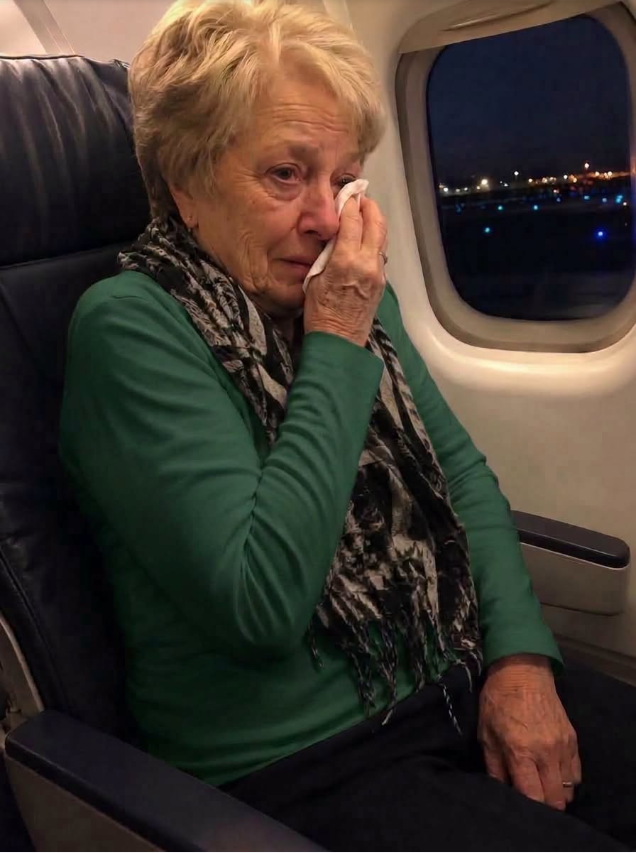
The man across the aisle slammed his magazine shut so hard that several passengers turned around.
That was the part I remember most.
Not his volume. Not the silence that followed.
The way Mom immediately folded inward, as though being spoken to cruelly was somehow proof that she had taken up too much space.
I had booked the window seat because she loved clouds.
For six months, her world had been chemotherapy rooms, blood tests, hospital corridors, and doctors speaking carefully about percentages. This was the first trip she had felt strong enough to attempt since her diagnosis, and I had wanted every minute to feel normal.
I pointed out planes on the runway.
Asked whether she wanted water.
Every few minutes she smiled and whispered something back.
Then, an hour into the flight, Richard Collins decided our voices were ruining his peace.
“You’ve been talking nonstop since takeoff,” he complained. “Some of us paid for a quiet flight.”
“I’m sorry,” I said. “We’ll keep it down.”
A flight attendant named Claire had noticed the argument.
“They need to be moved. They haven’t stopped talking.”
Something in her expression shifted.
“Ma’am,” she said gently, crouching beside her, “may I see your boarding pass?”
Claire examined the pass, then stopped at a notation near the bottom.
Richard leaned back looking satisfied.
Instead, Claire picked up the intercom phone.
“Captain,” she said quietly. “I think you should come out here.”
Minutes later, the cockpit door opened.
The captain stepped into the cabin.
He looked at the boarding pass.
Mom’s fingers tightened around mine.
Claire handed him another page attached to the boarding record—a passenger-care memo connected to Mom’s oncology clearance.
David barely seemed to notice Richard anymore.
“I’ve waited thirty-one years to see you again.”
Mom shook her head immediately.
“Still pretending you’re fine so everybody else can be comfortable?”
That sentence hit harder than anything Richard had said.
Mom had spent six months apologizing for needing help.
Claire quietly offered us two empty seats near the front.
As Claire helped her stand, the blanket slipped from Mom’s lap.
Richard saw the hospital wristband she had forgotten to remove.
The thin blue scarf covering hair that had only recently begun growing back.
At the front of the cabin, David sat opposite us.
I finally asked, “How do you know my mother?”
Thirty-one years earlier, David had been nineteen and training to become a pilot. One rainy November night, his motorcycle collided with a truck.
He arrived at St. Anne’s emergency department with internal bleeding.
“The resident thought I was simply in shock,” David explained. “Your mother disagreed.”
“Because your blood pressure was collapsing.”
“They found a ruptured spleen.”
“Another fifteen minutes and I probably wouldn’t be sitting here.”
“There were hundreds of patients.”
“That’s exactly what she always says. I may have been one of hundreds to her. She was one person to me.”
The oncology physician who had added the quiet passenger-care note to Mom’s reservation was David’s wife.
According to David, Elena had never forgotten what Mom told her that night:
“Never defend your first answer harder than you defend your patient.”
Elena carried that sentence through her entire medical career.
She eventually became an oncologist at St. Anne’s.
When Mom’s travel-clearance paperwork passed through her service, she recognized the name.
“She asked whether I was flying today,” David said.
“It gets worse. She tells residents your story.”
Before Mom could answer, Richard appeared near the galley.
“I just want to apologize,” he said.
David started to send him back.
“That isn’t why you were wrong.”
“You shouldn’t need to know someone has cancer before deciding not to humiliate them.”
Then Richard went back to his seat.
A few minutes later, Mom pressed a hand against her chest.
“Apparently you learned nothing.”
Claire checked her pulse and oxygen.
David called for medical assistance.
A physician from farther back examined Mom.
Her oxygen level was borderline.
Given her chemotherapy history, he recommended landing.
“I am not ruining everyone’s trip.”
“You spent six months surviving cancer treatment. You are allowed to inconvenience an airplane.”
The doctors there found severe dehydration, anemia, and an electrolyte imbalance.
That evening, Mom received a call.
“Elena Mercer,” the woman said.
They laughed like thirty-one years had disappeared.
Then Elena told Mom something that finally made her cry.
She had taught hundreds of young doctors the lesson Margaret gave her that night.
Years later, when Elena almost dismissed another patient’s symptoms, she remembered Mom’s warning and ordered one more test.
It saved a woman with leukemia.
“You never know how far one good decision travels,” Elena said.
The next afternoon, David and Elena met us at the hospital.
For two hours, nobody treated her like a cancer patient.
Three weeks later, her doctor cleared her to travel.
“If I wait until I’m not scared, I’ll never go anywhere.”
Halfway through the flight, the attendant asked what she wanted.
“What are we drinking to?” I asked.
“To being loud while we still can.”
Six months later, her scans showed no evidence of active disease.
A year after the original flight, St. Anne’s created a nursing scholarship in her honor.
The Margaret Ellis Speak Up Award.
It recognized nurses willing to challenge assumptions when they believed a patient was being overlooked.
“I spent thirty-one years believing Margaret saved one life that night,” he said.
“Elena taught me she saved many more.”
He had made a donation to the scholarship.
Mom accepted the apology without pretending the past had disappeared.
On the drive home, I asked her something.
“Do you ever think about what would’ve happened if Richard never complained?”
“You mean none of this would have happened?”
“No. Don’t give cruelty credit for the good things people choose afterward.”
“David surviving created this. Elena listening created this. Claire paying attention created this. You staying beside me created this.”
Then she turned toward the window.
“The bad moment was only loud. It wasn’t the most important thing.”
For years, I thought surviving cancer was the bravest thing my mother ever did.
Her greatest strength had always been the same thing David remembered from an emergency room thirty-one years earlier.
She noticed when something was wrong.
And she refused to stay silent simply because speaking made other people uncomfortable.
That flight began with a stranger telling Margaret Ellis to keep it down or get out.
A year later, I stood in an auditorium filled with doctors, nurses, pilots, and strangers applauding her for spending an entire lifetime doing exactly the opposite.


0 commentaires:
Enregistrer un commentaire