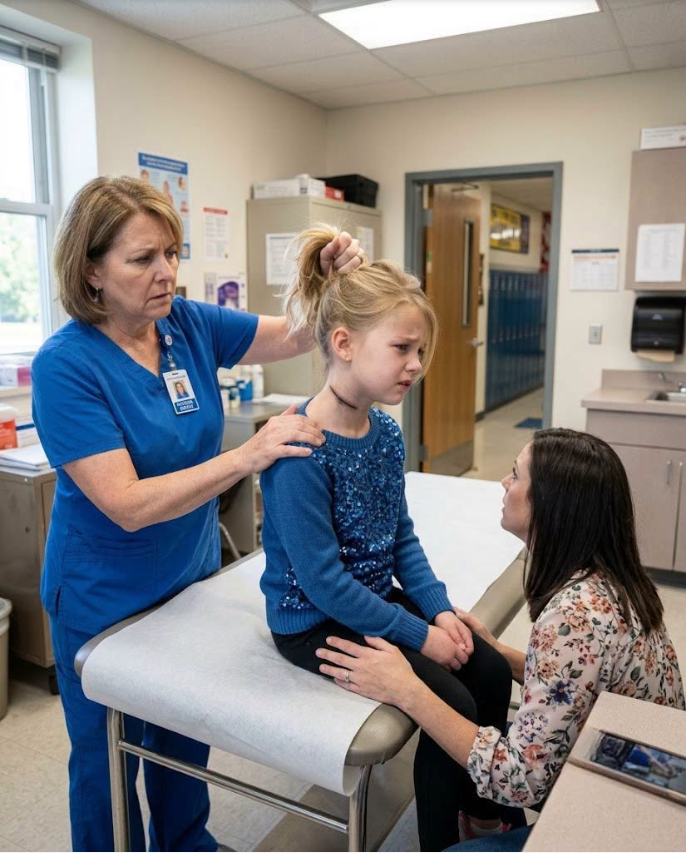
The doctor angled Chloe’s scan toward me and rested one finger beside a thin abnormal area along her neck.
He didn’t announce some dramatic diagnosis.
What he did instead frightened me more.
“This is not nothing,” he said.
Chloe sat beneath the thin hospital blanket with her chin tucked protectively toward her chest. She wasn’t watching the doctor.
He explained that the images showed a physical change in the same general area Chloe had been guarding—the area beneath the charcoal-colored line we’d found hidden under her hair.
The scan could show them that something looked abnormal. It could help guide what needed further evaluation.
It could not, by itself, tell us exactly how it happened.
But there was one thing he could say with confidence.
She had not refused lunch because she wanted to escape school.
She had not invented a sore throat because she’d learned which complaint would get her sent home.
Something hurt when she swallowed.
Something hurt when she moved her neck.
The doctor lowered himself until he was closer to her eye level.
“You did the right thing by telling people it hurt.”
Her shoulders dropped perhaps half an inch.
That tiny movement nearly broke me.
For three days, adults had been asking my seven-year-old to explain a sensation she didn’t have the vocabulary to describe.
She said her throat hurt because swallowing hurt.
She pointed to her neck because that was where she felt the pain.
She stopped eating because eating made it worse.
The first explanation hadn’t fit those facts neatly.
So instead of questioning the explanation, adults had started questioning Chloe.
I opened the six photographs on my phone.
The first was blurry because my hands had been shaking.
The second clearly showed the line.
The third captured the darker center.
The fourth showed the broken section near the right side.
In the fifth, the skin changed slightly as Chloe swallowed.
The doctor kept returning to the sixth.
“Did you see this before today?”
The answer came out too quickly.
“She dressed herself this morning. Her sweater comes up high, and her hair was down.”
My own mind was doing enough of that.
Why hadn’t Chloe told me until swallowing became painful enough that she stopped eating?
The doctor asked, “Do you remember when your neck first started hurting?”
Immediately, I pictured the school health log.
Monday, 11:58 a.m. Lunch refusal. Throat examined. No visible irritation.
Tuesday, 12:15 p.m. Repeat complaint. Refused food and water.
The entries had looked so calm.
“Do you remember anything else about Monday?” the doctor asked.
“Don’t force it,” he said immediately.
“We don’t need her to solve this for us right now.”
That sentence changed something.
Until then, every question had seemed like another test Chloe might somehow fail.
Could she simply want to go home?
Now, finally, someone was saying that a seven-year-old did not need to build a complete explanation before adults were required to take her pain seriously.
A nurse came in after the doctor stepped outside.
Before touching Chloe, she asked permission.
The nurse moved slowly, stopping whenever Chloe’s expression tightened.
When her fingers approached the dark line, Chloe crushed my hand.
“Not unless we need to. And if we do, we’ll tell you first.”
That was when I realized how much had happened to her that day.
Necessary things could still be frightening when you were seven.
When the doctor returned, he explained what they knew and, just as importantly, what they didn’t.
Chloe had repeatedly reported pain.
The pain affected eating, drinking, swallowing, and movement.
And the imaging gave them reason to continue evaluating the same area.
What caused it remained unanswered.
Oddly, that uncertainty steadied me.
I didn’t have to solve everything before sunset.
And refuse to let uncertainty become disbelief.
Mrs. Henderson sounded smaller than she had in her office.
“They’re still evaluating her.”
“The line beneath her chin. That it didn’t come off with gauze. Her pain with movement. And that you photographed it before leaving.”
“I should have looked where she pointed.”
She touched the outside of her neck.
She recoiled when I reached toward her hair.
She begged not to return to lunch.
Each clue alone was easy to explain away.
“I want a copy of the updated entry,” I said.
“And don’t replace the original notes.”
I wanted the whole sequence preserved.
Mistakes become dangerously tidy when people rewrite only the ending.
When I hung up, Chloe asked, “Do I have to go back?”
“We don’t have to decide tomorrow yet.”
Then leaned sideways until her shoulder touched my arm.
A little later, the doctor returned and asked whether Chloe wanted him to explain the scan to her too.
He explained that the pictures helped them look beneath the skin and compare what they saw with where she reported pain.
Then he repeated something she clearly needed to hear.
“Nobody here thinks you’re making it up.”
Chloe finally looked directly at him.
“Even if my throat looks normal?”
And suddenly I understood what had frightened her almost as much as the pain.
She thought the normal throat examination had disproved her.
Adults had looked in the wrong place and treated what they didn’t see as evidence against the child describing her own body.
The doctor corrected that without making a speech.
He believed the symptom before understanding its cause.
That shouldn’t have felt extraordinary.
By early evening, Chloe had relaxed enough to ask whether she could have a popsicle once the doctor allowed it.
Then she changed her mind to apple juice.
Each indecisive request sounded beautifully ordinary.
Glitter embedded permanently in my sofa.
But some days divide your life into before and after.
Before someone suggested Chloe had learned how to get sent home.
After someone looked at the evidence and said, This is not nothing.
Eventually, we were given clear follow-up instructions and told what changes required immediate medical attention.
I requested the school records.
Not because I had already decided who was responsible for what.
I simply understood now that details mattered.
So did preserving what people knew before hindsight changed their memories.
In the parking lot, I helped Chloe into the car without pulling anything over her head.
She asked me to crack the window.
Then she noticed something stuck to my boot.
The little silver sticker from her school folder was still there.
I’d noticed it hours earlier at a traffic light.
I peeled it off and held it toward her.
Maybe nothing more complicated than remembering her sticker.
Seven-year-olds are allowed to say things without being required to produce the complete meaning behind them.
I pressed the crooked silver star onto my phone case.
“You believed me before the picture, right?”
My hands tightened around the steering wheel.
I could have given her the perfect parental answer.
Instead, I gave her the true one.
“I believed that you hurt. I didn’t understand why yet.”
After the water spilled across the health log.
After a child refusing lunch became a child whose pain had been visible all along.
“Yes,” I said. “She looked after.”
Chloe rested her head carefully against the seat.
There would still be medical follow-up.
There would be conversations with the school.
There were questions I desperately wanted answered, but I would not force Chloe to answer them before she was ready or turn possibilities into facts simply because I was frightened.
For now, something more fundamental had changed.
Chloe no longer had to prove that pain existed simply because the first examination had been normal.
The adults around her now had to begin with the fact that it did.
By the end of the week, the silver star on my phone was barely hanging on.
Because that Tuesday taught me something I never wanted to forget.
Children don’t always describe pain in language adults find convenient.
They say, “My throat hurts,” because swallowing hurts and they don’t know what else to call it.
The burden cannot be on a seven-year-old to sound convincing enough.
Sometimes our job is simply to notice when the pieces don’t fit and keep looking.
That afternoon, everyone had looked inside Chloe’s throat and found nothing.
It had been less than two inches away, hidden beneath her hair, exactly where my daughter had been pointing all along.
And once somebody finally believed that not having an explanation wasn’t the same as not having a problem, Chloe stopped trying to convince the room that she was hurting.
She could finally let the adults take care of her.


0 commentaires:
Enregistrer un commentaire