The first thing I remember about Saint Luke Medical Center is the light.
Harsh fluorescent tubes buzzed above the emergency waiting room while I sat beneath them with both hands clenched into fists, staring at nothing.
My wife still had not come to the hospital.
That fact refused to fit inside my head.
Our eight-year-old son had been found staggering down a Birchwood sidewalk with one shoe missing, blood near his ear, and half his face already beginning to swell.
Our elderly neighbor, Mrs. Johns, had called the ambulance.
The doctors had used words like concussion and possible swelling. More scans were coming. More observation.
I knew what careful voices meant.
I had spent years around people trained to deliver terrible information without making panic worse.
Most people in Birchwood knew me as Daniel Sinclair.
The guy who cut his lawn on Saturday mornings and burned the first pancake every weekend.
They knew almost nothing about the man I had been before Toby was born.
I stood so quickly the chair scraped behind me.
“He’s awake. He keeps asking for you.”
I followed her through the double doors.
The hallway smelled of bleach and stale coffee.
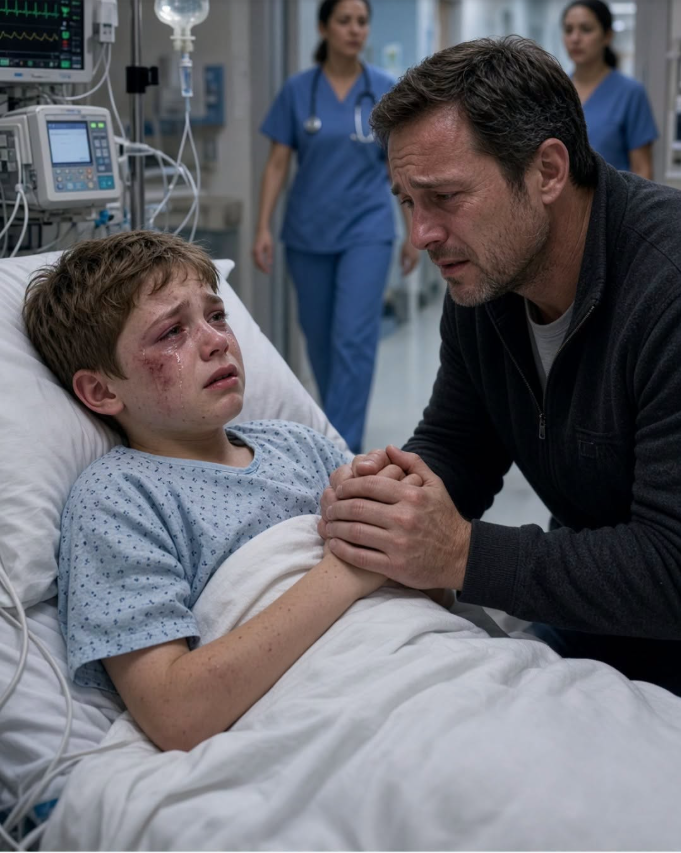
When I entered Toby’s room, something inside me nearly collapsed.
He looked impossibly small beneath the hospital blanket.
The right side of his face was swollen. Purple bruising had already begun spreading beneath the skin. Tiny cuts marked his cheek.
I crossed the room and sat beside him.
“You don’t need to tell me anything right now.”
“He said you think you’re better than the family.”
Isabelle’s father had never liked me.
Neither had her brothers, Jasper and Kyle.
They knew I had once done work overseas.
“Uncle Jasper grabbed my arms.”
Children sometimes need to finish horrible stories because unfinished stories still feel dangerous.
“Grandpa smashed my head on the driveway.”
For several seconds, all I could hear was the monitor beside him.
I had witnessed violence before.
I had seen men behave terribly when fear, rage, pride, or power stripped away the civilized version of themselves.
But nothing had prepared me to hear my son describe three grown men pinning him against concrete.
“Grandpa said, ‘Your daddy’s not here to protect you.’”
I leaned forward and kissed the only place near his hairline that did not look hurt.
Then came the sentence that would stay with me longer than all the others.
“Daddy… Grandpa said you weren’t coming.”
I closed my eyes for half a second.
That was the cruelty beneath the beating.
They wanted him to believe he was alone.
That his father had abandoned him before he even knew he was in danger.
He tightened his fingers around mine.
The doctor returned a few minutes later.
Forced myself to separate what they knew from what they feared.
Those habits came from another life.
A life Birchwood knew nothing about.
A life where panic could get people killed and information mattered more than emotion.
But when I stepped into the hallway, emotion was exactly what I had.
Clean, immediate, almost comforting rage.
My phone was already in my hand.
There was one number I had not used in years.
Connected to men who remembered me before marriage, mortgages, and Saturday soccer.
The line connected immediately.
I looked through the glass at Toby.
His small hand rested on the blanket.
For one dangerous second, I could have given three names.
“I want that driveway preserved before anyone cleans it. Neighbor cameras. Doorbells. Messages. Call records if law enforcement can obtain them. Nothing illegal. Nothing touched that shouldn’t be touched.”
Then the man said, “You’ve changed.”
That was the moment I understood what Toby needed from me.
Evidence that would still exist tomorrow after frightened adults had coordinated stories.
Evidence family loyalty could not erase.
I had spent years letting family arguments end when they became uncomfortable.
That silence told me more than any answer.
After we disconnected, the doctor returned.
“We have mandatory procedures when a child arrives with injuries like these.”
People whose judgment did not depend on whether my father-in-law sounded convincing.
“I want to speak with whoever handles that.”
Toby opened his eyes immediately.
For the next twenty minutes, we talked about nothing important.
A science project he had forgotten.
The Lego spaceship still sitting unfinished on his bedroom floor.
I needed him to remember the world was larger than one terrible driveway.
“He came down the sidewalk alone. One shoe missing. Kept looking behind him.”
“Did you hear anything earlier?”
“Jasper’s truck. And I think Kyle’s SUV was around the side.”
Mrs. Johns saw him afterward, injured and alone.
“Please don’t erase anything from your doorbell camera,” I said.
“If it caught Toby, it may matter.”
Minutes later, another secure message arrived.
Scene appears intact. Two neighboring cameras likely have coverage.
Because the men in that driveway had expected one of two things.
Either I would never find out what really happened—
or I would become angry enough to make a mistake.
Footsteps approached outside Toby’s room.
Another belonged to someone official telling her to wait.
I looked back at my sleeping son.
Grandpa had told him his father was not coming.
In one sense, he had been right.
The furious man they expected never arrived.
Instead, Toby’s father showed up.
And this time, I was going to make sure the truth stayed long enough for everyone else to see it too.


0 commentaires:
Enregistrer un commentaire