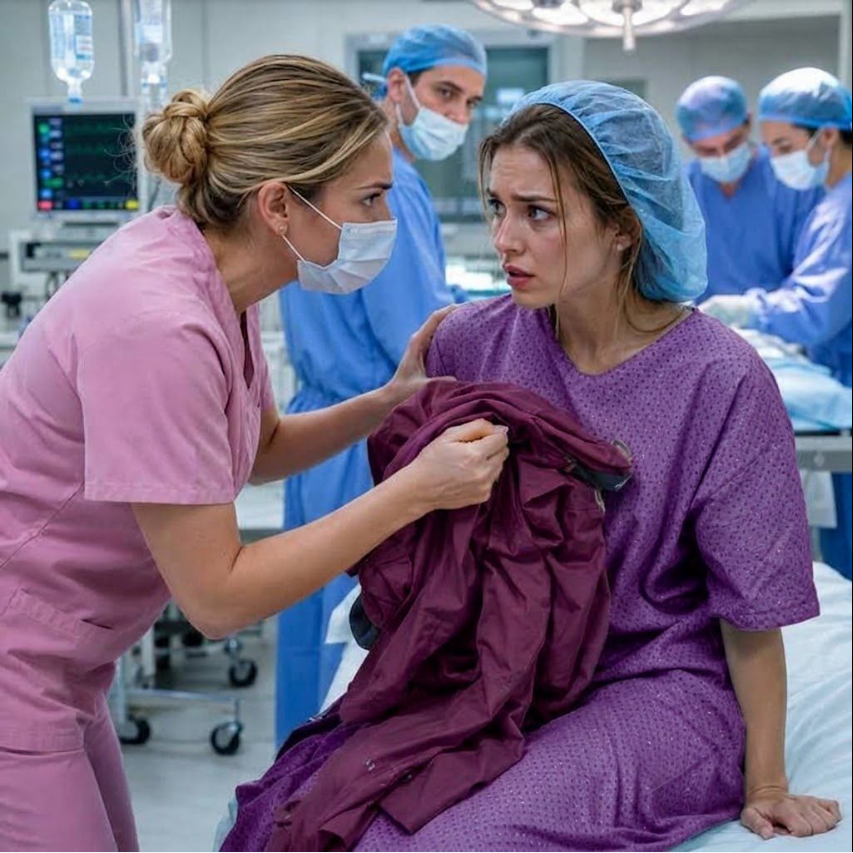
Elena’s hand closed around the service-door handle just as footsteps stopped outside my hospital room.
She looked at me once, pressed a finger to her lips, and cracked the door open.
The narrow corridor smelled of detergent and disinfectant. Linen carts stood against the walls, stacked with folded sheets. I was still wearing my hospital gown beneath the gray janitor uniform Elena had shoved over me, and the plastic identification band scraped my wrist every time I moved.
Less than an hour earlier, I had been lying calmly in pre-op, waiting to donate a kidney to my husband.
Behind us, my room door opened.
My body almost turned toward it automatically.
For years, Diego’s voice had meant safety. He knew how I liked my coffee, had once driven forty minutes back home because I forgot my work keys, and sat beside me through my father’s hospital stays without complaining.
When Dr. Salgado told us Diego was dying of kidney failure, Diego had cried against my shoulder.
“I’d rather die than let you hurt yourself for me.”
Now Elena pulled me behind a tall linen cart while voices poured into the corridor.
“What do you mean she’s gone?” Beatriz demanded.
“She can’t be far,” Fernanda said.
Then Salgado’s voice, low and controlled.
“Quiet. There are staff members everywhere.”
I pressed both hands over my mouth.
Something inside me went completely still.
“What?” Beatriz snapped. “That’s what she is to them now. If this falls apart, none of us gets anything.”
The corridor turned toward a secured stairwell. Elena swiped her badge and pushed the door open.
Before it closed behind us, Diego shouted my name again.
Not the staggering walk of a man supposedly too sick to cross our apartment without help.
Not the weak steps of the patient who had arrived in a wheelchair that evening.
“You said his results were falsified. Show me something real.”
“I spent two months preparing to cut open my body for that man. Give me one thing I can trust.”
Elena hesitated, then reached beneath her scrub jacket.
She unfolded two laboratory reports.
One was the report Salgado had shown us.
The other did not describe a man dying from kidney failure.
“I found the original while reconciling his file,” Elena whispered. “I thought someone attached the wrong page. Then I checked the history.”
She pointed toward the timestamps.
“The abnormal version was entered later.”
“I can’t prove who typed it. But Salgado signed the note that relied on it.”
We hurried down another flight.
“Ana, stop! Elena is confused!”
Elena pointed toward a loading corridor.
The loading dock would be deserted.
I had no phone, no wallet, no shoes beyond hospital socks, and no idea who else Salgado controlled.
If I disappeared through a back exit, Diego could claim I had panicked.
He could say Elena abducted me.
“I’m not leaving through the back.”
For the first time that night, I was making a decision that had nothing to do with saving Diego.
We were almost into the public corridor when Dr. Salgado appeared ahead of us.
The calm expression I had seen during every appointment was gone.
“Ana,” he said. “Come upstairs.”
“You are under extreme emotional stress.”
“I do not consent to surgery. I do not consent to medication. I do not consent to going anywhere with you.”
A woman near the vending machines.
A receptionist behind the desk.
He slowed the moment he noticed the audience.
“Ana,” he said softly. “Come here.”
That sentence had controlled me for years.
Beatriz and Fernanda appeared behind him.
Beatriz tried to soften her face.
“Sweetheart, you misunderstood.”
“You have no idea what is at stake.”
Whatever they expected to gain.
“She is a preoperative patient experiencing acute anxiety. She needs to return upstairs.”
I walked directly to the receptionist.
“Call outside law enforcement. And call whoever runs this hospital tonight. I believe my medical records were falsified, and I am refusing all treatment.”
The receptionist reached for the phone.
She let everyone see exactly what he would choose to do.
“You are destroying our lives,” he whispered.
“You watched me sign consent papers.”
His eyes flicked toward the people watching us.
Then Fernanda began backing away.
“You said there was no other way.”
“You said she would never know.”
“You promised she would already be unconscious before anything changed.”
The security supervisor arrived moments later and asked me one question.
“Do you want to leave with any of these people?”
“Do you want any of them making decisions about your care?”
Just two answers spoken where everyone could hear them.
Elena handed over the conflicting lab reports only after I gave her permission.
Salgado called it an administrative error.
“That’s what you’re calling it now?”
By morning, the gray janitor uniform was still hanging from my body.
My wristband was photographed before they removed it.
The investigation unfolded slowly.
There was no single perfect document exposing everything.
Instead, the truth appeared in pieces.
Conflicting laboratory reports.
Surgical scheduling that did not match the kidney donation I had authorized.
My original consent said one thing clearly.
Diego’s real medical records showed he did not have the end-stage renal failure I had been told he had.
The future he said we would have after I saved him.
All of it had been built around getting me into that operating room willingly.
Investigators later uncovered evidence of an illegal arrangement involving money, Salgado, and people connected to someone waiting for a heart.
I eventually stopped asking who the intended recipient was.
Their tragedy did not explain my husband’s choice.
He claimed he believed someone would stop everything before I was seriously hurt.
But lies built over months eventually collapse beneath their own weight.
He watched his mother count my vitamins.
He watched me sign the paperwork.
He kissed my forehead while knowing I was preparing to sacrifice myself for an illness he did not have.
And when I escaped, he did not call after me like a frightened husband.
Fernanda eventually cooperated.
She never asked for forgiveness.
That may have been the first decent thing she did.
She admitted that everyone knew I was not supposed to wake up and learn what had really happened.
Beatriz continued calling it desperation.
I believed she had been desperate.
I did not believe desperation erased choice.
Nearly a year later, I found the gray janitor uniform folded inside a storage box.
I stood there holding it for a long time.
One sleeve still had a faint crease where Elena had pulled it over my hospital bracelet.
That uniform had once been a disguise.
Then it became an escape route.
Now it was simply proof that one person had looked at me in a room full of people making decisions about my body and remembered something they had forgotten.
I was still a person who could say no.
I met Elena after her shift and handed her the uniform.
We finished our coffee and walked toward the hospital entrance together.
At the doors, Elena turned toward the staff corridor.
This time there was no hidden passage.
No husband calling my name behind me.
No mother-in-law deciding what my body was worth.
I pushed open the front doors myself.
And walked outside as nobody’s merchandise but my own person.


0 commentaires:
Enregistrer un commentaire