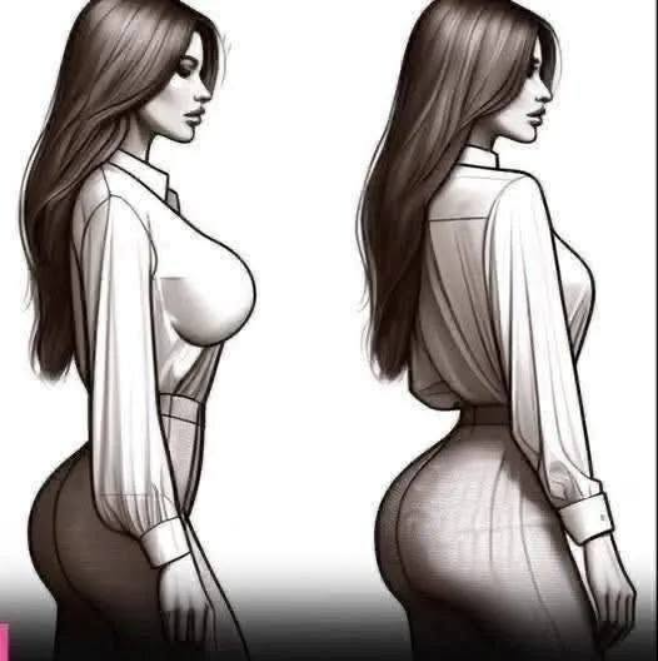
A provocative claim has been circulating online suggesting that a woman's breast size supposedly reveals something about her intimate anatomy.
The headline is designed to make people curious, but there is no reliable medical rule that allows someone to determine the size, shape, or characteristics of a woman's internal reproductive anatomy simply by looking at her breasts.
In other words, breast size does not provide a secret map of what is happening inside the body.
Breast size varies enormously from one person to another.
Much of that variation is influenced by genetics, hormones, body composition, age, pregnancy, breastfeeding, and changes in weight.
Breasts are primarily made up of fatty tissue, glandular tissue, connective tissue, blood vessels, and other structures.
The amount and distribution of these tissues differ between individuals.
That is why two women of the same age and similar body shape can have very different breast sizes.
The internal reproductive organs—including the uterus, ovaries, fallopian tubes, cervix, and vagina—are separate anatomical structures.
Their characteristics cannot reliably be predicted from breast size.
Even people who have similar breast measurements can have differences in their reproductive anatomy, just as people with different breast sizes can have similar internal anatomy.
There is simply no medically established formula connecting the two.
There is one reason the myth may sound believable: hormones influence many aspects of sexual development.
Estrogen and other hormones play important roles in breast development as well as reproductive development.
But that doesn't mean one visible characteristic can be used to predict another.
Human biology is far more complicated than a simple “small means this” or “large means that” rule.
Another common misconception is that physical appearance can reveal how someone will experience intimacy.
Sexual sensation and function involve nerves, blood flow, hormones, psychological factors, relationships, medications, health conditions, and many other variables.
Breast size does not determine sexual desire, sexual satisfaction, fertility, or a person's ability to experience pleasure.
Sensational body-related claims are especially effective on social media because they promise readers a “secret” about human anatomy.
A headline might suggest that a visible physical feature reveals something hidden.
That creates curiosity—and encourages people to click or share before checking whether the claim is supported by medical evidence.
Once repeated often enough, a myth can begin to sound like established fact.
But repetition isn't scientific evidence.
It's important to remember that appearances rarely tell the whole story about someone's health or anatomy.
A person's breast size, waist shape, height, or other physical characteristics cannot reliably reveal the condition of their internal organs.
When doctors need information about internal anatomy, they use appropriate medical history, physical examination, imaging, laboratory testing, or other diagnostic methods—not visual assumptions based on body shape.
There is also a broader lesson behind this particular myth.
Human bodies don't follow one universal template.
Breasts can be small, large, asymmetrical, or change significantly over time. All of these variations can occur in healthy people.
Comparing someone's body with an imagined “standard” can create unnecessary anxiety and unrealistic expectations.
The viral suggestion that small breasts reveal something specific about a woman's “inner part” is not supported by established medical evidence.
Breast size is influenced by genetics, hormones, body composition, age, and other factors, while internal reproductive anatomy varies independently.
So the next time you encounter a headline promising to reveal a hidden truth about a woman's body based on one physical feature, remember:
Human anatomy is more complicated than a viral headline—and appearance alone cannot reveal what's happening inside the body.



0 commentaires:
Enregistrer un commentaire