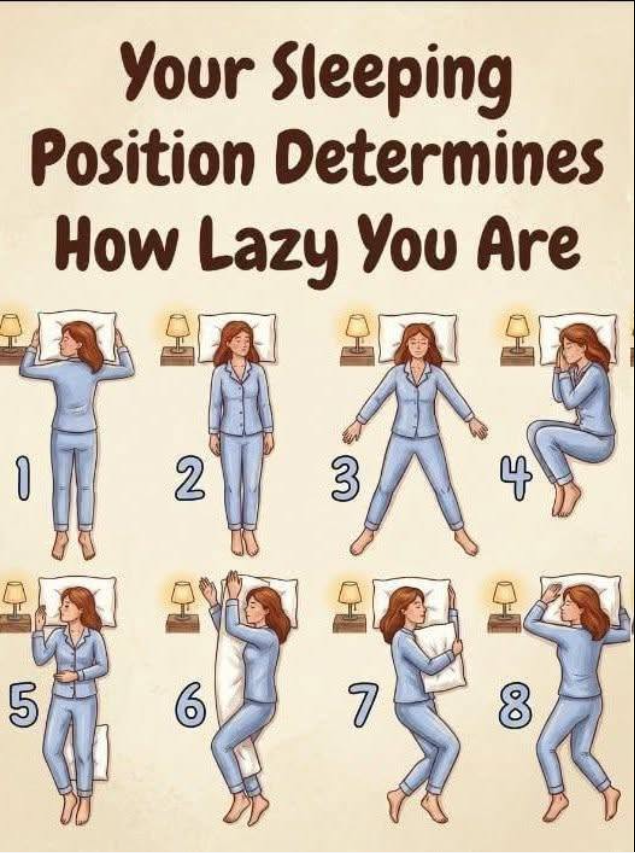
Maybe you curl up tightly on your side, stretch out across the entire bed, sleep flat on your back, or bury your face into the pillow.
You might even change positions throughout the night without realizing it.
People have long been fascinated by the idea that the way we sleep can reveal something about our personality. Some popular theories claim that certain positions are associated with confidence, sensitivity, independence, or even laziness.
But there is an important distinction between sleeping-position folklore and scientific evidence.
There is no reliable scientific test that can determine whether someone is lazy, confident, shy, or outgoing simply by looking at how they sleep. Your preferred position is influenced by comfort, habits, body structure, pain, temperature, mattress quality, pregnancy, breathing patterns, and many other factors.
Still, different sleeping positions can be interesting to explore—and some may provide clues about your comfort preferences, sleep habits, and physical health.
So tonight, before you drift off, take a moment to notice how you’re lying there.
You might learn something interesting about your sleep after all!!
Most of us don’t consciously choose a sleeping position every night.
We simply settle into whatever feels comfortable.
Over time, however, the body can develop familiar sleep habits. You may automatically roll onto your side as soon as your head hits the pillow or instinctively stretch your legs out when you’re ready to relax.
Your preferred position can also change.
An old mattress, a sore shoulder, pregnancy, an injury, changes in body weight, room temperature, or even a new pillow can make a once-comfortable position suddenly feel wrong.
And there’s another fascinating detail: the position you fall asleep in isn’t necessarily the position you spend the whole night in.
So when we’re talking about “your sleeping position,” we’re really talking about a preference rather than a fixed posture.
Side sleeping is extremely common.
You may sleep with your knees slightly bent, your legs stretched out, or curled into a tighter position.
Some people hug a pillow while sleeping on their side, while others tuck their arms underneath the pillow.
Traditional sleep-position folklore sometimes describes side sleepers as thoughtful, sensitive, dependable, or somewhat guarded.
People who sleep curled up tightly are sometimes portrayed as cautious or emotionally protective.
But again, these are personality interpretations—not scientifically established facts.
Your brain isn’t secretly announcing your personality through the way your knees are positioned!!
Side sleeping can be comfortable for many people and may be particularly useful for people who find back sleeping uncomfortable.
For some people, sleeping on the side can also make breathing easier than lying flat on the back.
If you frequently wake with shoulder, hip, or neck discomfort, however, your pillow height and mattress support may be worth examining.
This is one of the most recognizable sleeping positions.
You lie on your side and draw your knees toward your chest, sometimes wrapping your arms around a pillow.
Popular interpretations often associate the fetal position with people who are sensitive, cautious, or comfort-seeking.
Some versions of the theory even claim that people who curl up tightly are hiding from stress.
But there’s no reliable evidence that your sleeping posture can tell us whether you’re emotionally guarded or sensitive.
Sometimes a person simply finds curling up comfortable!!
If you sleep curled tightly, try not to pull your knees all the way toward your chest for the entire night if it leaves your back feeling stiff.
A pillow between the knees may provide additional comfort and help support a more neutral hip and spine position.
Back sleepers lie face-up with the head supported by a pillow and the arms either beside the body, across the stomach, or above the head.
Back sleepers are sometimes described as confident, independent, organized, or comfortable being the center of attention.
But there’s no scientific personality test hiding underneath your pillow.
Someone can be outgoing and sleep on their side.
Someone can be shy and sleep on their back.
And someone can change positions five times before breakfast!!
Back sleeping can feel comfortable for some people because it allows the body to rest in a relatively symmetrical position.
However, sleeping flat on the back can worsen snoring or symptoms of obstructive sleep apnea in some people.
If you regularly snore loudly, wake gasping or choking, experience witnessed pauses in breathing, or feel excessively sleepy during the day, it’s worth discussing those symptoms with a healthcare professional.
Stomach sleeping means lying face-down, usually with the head turned to one side.
Some people absolutely love it.
Others can’t imagine sleeping that way for even five minutes!!
Popular sleep-position articles sometimes describe stomach sleepers as bold, stubborn, impulsive, or outgoing.
But once again, those labels aren’t scientifically reliable.
Your favorite position isn’t a personality test.
There is a practical reason some stomach sleepers wake up feeling stiff.
Because your head usually has to turn to one side so you can breathe, your neck may remain rotated for a long period.
If you regularly wake with neck or back discomfort, experimenting with a different position or pillow arrangement may help.



0 commentaires:
Enregistrer un commentaire